
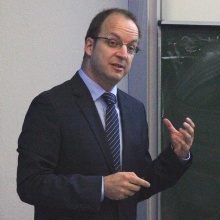
male teacher in front of blackboard

Education

Research Facility for Subsurface Remediation (VEGAS)

We are delighted to see how students improve over time and cherish teaching. We also offer and supervise interesting topics for BSc and Msc theses. We offer thesis topics in our chemistry lab, in performing contaminant and heat transport experiments in the lab and in the field, and in mathematical modelling. We value education and teach courses in Environmental Engineering, Civil Engineering, Water Resources Engineering and Management as well as in the “Fortbildungsverbund Boden und Altlasten Baden-Württemberg ”

Offered BSc./M.Sc theses

VEGAS offers a variety of different bachelor / master theses for the study programs Environmental Engineering, Civil Engineering, WAREM and WASTE. A selection is shown in the following list. Beyond that, we often have exciting new tasks on the development of remediation technologies on different scales, geothermal energy, measurement technology and exploration as well as heterogeneity and multivariate statistics. Just contact  Simon Kleinknecht, Claus Haslauer, or Tobias Junginger. if you are interested!

A variety of low-cost sensors exist that wait to be exploited for geohydrological applications:
- soil moisture sensors
- scales in python or with arduino
- temperature sensors
- CO2 sensors
and many more.

The broad goal of this thesis is to evaluate to what extent sensors driven from the maker:space are suitable for geohydrologic investigations such as thermal in-situ remediation systems
.
Prospective Tasks
- Establish setups of novel measurements and compare to
- established measurement techniques
- The specifics will be determined jointly
- Visualization and statistical analysis of results and discussion

Desireable Skills
- some experience in python and electronics (raspberry,
- microcontrollers) would be ideal
- Interest in practical work
- Motivated and creative thinking

Supervisor : PhD-student: Anna Burkhardt

Type: Bachelor Thesis, Master Thesis
Organisation: Research Facility for Subsurface Remediation (021499)
Supervisor:
Examiner: Claus Haslauer
Link: To C@MPUS

The unsaturated zone in the subsurface above the water table plays an important role for water infiltration and contaminant transport (“contaminants of emerging concern” such as PFAS).

The key soil property of a soil responsible for transmitting water is the capillary pressure – saturation relationship. The goal of this M.Sc. thesis is to establish a set of parameters and associated uncertainty estimates for a number of typical porous media used in our laboratory.

These parameters will then be improved input parameters for estimating contaminant mass fluxes to the groundwater and potentially to drinking water wells.
Prospective Tasks:
▪ Familiarize yourself with water flow processes in the unsaturated zone, as well as the concepts and methodology of our measurement setup.
▪ Perform a set of experiments to measure capillary pressure – saturation relationships of soil samples.
▪ Analyze those experiments and fit models for the capillary pressure – relationships in order to obtain a set of parameters including uncertainty estimates.

Desireable Skills:
▪ Experiences in laboratory work is a plus. We are looking for a person with the ambition to work in a soil laboratory.
▪ Ideally some python or other data wrangling skills.

Keywords: Geohydrology, Hydrology, Statistics, Data Analysis, Groundwater Modelling

Type: Master Thesis
Organisation: Research Facility for Subsurface Remediation (021499)
Supervisor:
Examiner: Claus Haslauer
Link: To C@MPUS

M.Sc. Topic – Environmental Analytical Chemistry
Per- and polyfluoroalkyl substances (PFAS) pose a serious environmental threat due to their persistence, mobility, and toxicity. Despite increasing regulatory efforts, there is currently a lack of effective forensic tools to trace contamination sources and apply the polluter-pays principle. This master’s thesis aims to develop an innovative compound-specific isotope analysis (CSIA) method for PFAS using high-resolution Orbitrap mass spectrometry (HRMS). The focus will be on establishing reliable analytical protocols for selected PFAS starting with TFA, and potentially with PFBA, PFBS, PFOA and PFOS, with an emphasis on quantifying stable carbon (13C/12C), sulfur (34S/33S/32S) and oxygen (18O/16O) isotope ratios.

The thesis includes the systematic development of Orbitrap-based CSIA methods (optimizing ionization, scan parameters, and fragmentation behavior) for selected PFAS. The ultimate goal is to generate reproducible isotopic “fingerprints” that allow for source attribution dependent on production methods or degradation processes. The results will support environmental forensic investigations, help identify responsible polluters, and contribute to more targeted and effective remediation strategies. The master thesis offers a unique intersection of environmental chemistry, high-resolution mass spectrometry, and applied environmental science.

Prospective Tasks
- Literature review on CSIA, HRMS and the application of HRMS to measure stable isotopes.
- Systematic HRMS-CSIA method development for TFA (+ other compounds) and data evaluation
- Development of Step-by-Step guides to apply the methods
- Visualization of results and discussion

General Information
- The thesis can be co-advised/examined by a different department (e.g., chemistry)

Type: Master Thesis
Requirement: Desireable Skills
- Background in environmental/ analytical chemistry (preparation of analytical standards, work with mass spectrometers), laboratory skills. Understanding of stable isotope principles (CSIA) is helpful but not mandatory; willingness to learn is essential
- Innovative and critical thinking & scientific curiosity
- Attention to detail and documentation (lab reports, thesis)
- Communication Skills
Organisation: Research Facility for Subsurface Remediation (021499)
Supervisor:
Examiner: Tobias Junginger
Link: To C@MPUS

M.Sc. Topic – Water Treatment/Environmental Chemistry
Per- and polyfluoroalkyl substances (PFAS) represent one of the most persistent classes of environmental contaminants. Their exceptional chemical stability makes conventional water treatment technologies largely ineffective. Recent studies suggest that far-UVC irradiation (e.g., 222 nm KrCl excimer lamps) can induce photolytic PFAS degradation, especially for long-chain perfluorocarboxylic acids. However, degradation is often incomplete and leads to the formation of shorter-chain transformation products that remain persistent. In contrast, 172 nm Xe2 excimer lamps provide photons of substantially higher energy, potentially enabling more effective PFAS destruction. Yet, scientific knowledge on their degradation mechanisms, efficiency, and transformation pathways remains extremely limited. Strong light absorption by water, altered radical chemistry, and potentially different reaction pathways make 172 nm irradiation a largely unexplored but promising technology.

This Master thesis will investigate the degradation of PFAS under 172 nm irradiation in a dedicated excimer-lamp reactor system. The work aims to systematically evaluate degradation efficiency, chemical mechanisms, transformation products, and mineralization (fluoride release), thereby laying essential groundwork for future reactive water treatment applications.

Prospective Tasks
- Comprehensive literature review on PFAS photolysis & excimer-lamp technologies
- Experimental design and execution of degradation experiments using a Xe2 172 nm excimer lamp system with systematic investigation of reaction conditions
- Analytical quantification of parent PFAS and transformation products (TPs) using targeted and non-targeted HRMS approach and assessment of mineralization efficiency
- Elucidation of degradation pathways, comparing observed TPs with proposed mechanisms in the literature
- Evaluation of technology potential and limitations for environmental application
- Visualization of results and discussion
- Documentation, visualization, and interpretation of results in a scientific thesis

Type: Master Thesis
Requirement: Desireable Skills
- Background in environmental chemistry, ideally experience with LC-MS(/MS) or HRMS
- Strong laboratory and technical skills (sample preparation, aqueous chemistry, safe lab practices, operation of experimental setups)
- Ability to work independently, carefully, and with strong documentation habits
- Critical thinking and scientific curiosity
Organisation: Research Facility for Subsurface Remediation (021499)
Supervisor:
Examiner: Tobias Junginger
Link: To C@MPUS

Impressions from the field course hydrogeology 2022

01:40

VEGAS maintains a hydrogeological testing site, near the town of Horkheim close to the river Neckar. This site is well equipped for hydrogeologic field tests, such as pumping tests, slug tests, tracer tests, borehole dilution tests and others. The key component of the course is a 2-day visit at the field site during which students learn hands-on hydrogeologic testing procedures. The video gives an impression of the activities during the summer term 2022 at the Horkheim site.

To the top of the page